
Sliding Filament Theory
1. The binding of Ca2+ to troponin causes the tropomyosin-troponin complex to be rearranged
- This exposes the myosin-binding sites on the G actin
2. The ATP-bound myosin heads (low energy state) then hydrolyse ATP to ADP and Pi (high energy state) and bind to the G actin binding sites, forming crossbridges
3. When ADP and Pi are released, the myosin heads return to their low energy state and pull the thin filament towards the centre of the sarcomere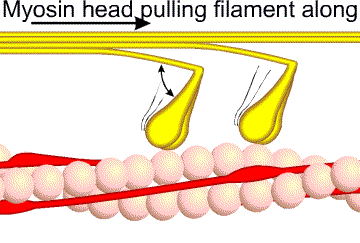
4. The crossbridge is broken upon binding of a new molecule of ATP and the cycle repeats (but on a new G actin site farther along the thin filament)
- Each myosin head forms and reforms about 5 crossbridges per second
5. The whole process stops when Ca2+ unbinds from troponin and the G actin sites are covered
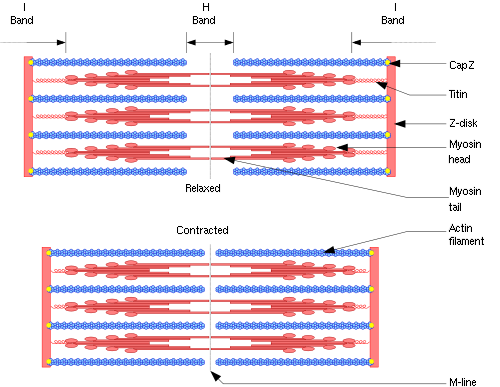
The process does not shorten any filaments
Contraction is brought about by pulling the Z discs in towards the middle
Whole muscle contraction is brought about by the the contraction of many muscle fibres